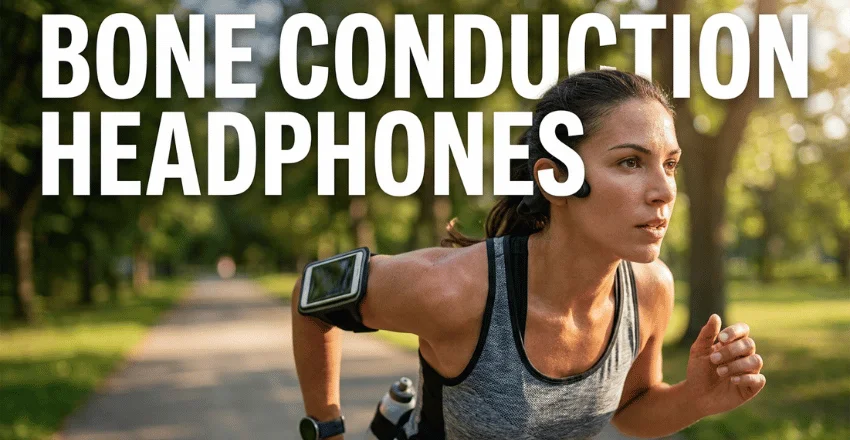
Bone conduction headphones transmit vibrations through the bones around your ears to your inner ear rather than sealing the ear canal. This keeps your ears open to outside sounds, which is useful for running, cycling, work, and some swimming activities. The tradeoff is that surrounding noise can compete with what you’re listening to.
They solve a different problem from conventional earbuds. The goal isn’t maximum isolation. Instead, they let you listen to audio while keeping your ear canals open and maintaining greater awareness of what’s happening around you.
| Key point | What it means |
|---|---|
| Listening method | Vibrations travel through the skull toward the inner ear |
| Ear canal | Remains open |
| Strongest use cases | Running, cycling, workouts, some workplaces, and swimming with suitable models |
| Main advantage | Greater awareness of surrounding sounds |
| Main compromise | Less isolation from outside noise |
| Hearing safety | Safe listening volume still matters |
| Swimming | Requires a properly waterproof model; onboard audio storage is useful underwater |
Key Takeaways
- They leave the ear canal open instead of plugging it with a speaker.
- They are especially useful when environmental awareness matters.
- They don’t make loud listening harmless.
- Traditional earbuds usually suit people who want stronger sound isolation.
- Swimming requires a model designed for immersion, not merely sweat resistance.
- People with hearing loss should distinguish consumer headsets from medical hearing devices.
How Bone Conduction Headphones Work
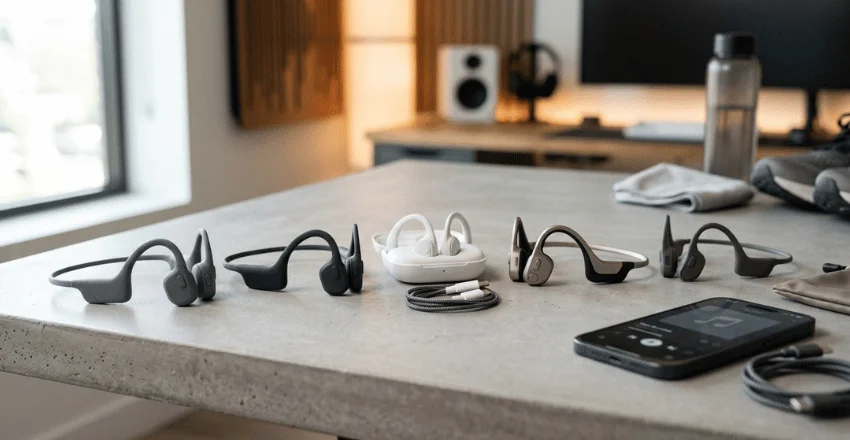
Normal air-conducted sound enters the ear canal, moves the eardrum, and eventually creates vibrations inside the cochlea. The cochlea converts those vibrations into nerve signals that the brain interprets as sound.
Bone conduction uses a different route. A small transducer rests against the head and converts audio into mechanical vibrations. Those vibrations travel through the skin and skull toward the cochlea without relying on the open ear canal as the primary pathway.
The concept isn’t limited to consumer audio. The National Institute on Deafness and Other Communication Disorders describes bone-anchored hearing devices, which transmit vibrations through the skull to the inner ear. Consumer headsets, however, aren’t the same as implanted medical devices.
Why People Choose Open-Ear Vibration Audio
The biggest advantage is situational awareness. Traditional in-ear headphones can reduce your ability to hear traffic, conversations, alarms, bicycles, and other nearby sounds. An open-ear design keeps those environmental sounds audible because nothing seals the ear canal.
That makes this style attractive to:
- Runners on roads or shared trails
- Cyclists who need to monitor traffic
- Gym users who dislike earbuds shifting during exercise
- Office users who still need to hear colleagues
- People who find in-ear tips uncomfortable
- Swimmers using a purpose-built waterproof model
Techriyon readers comparing different workout-oriented designs may also find the site’s Beats Fit Pro vs. AirPods Pro comparison useful. It covers two conventional earbud approaches and their tradeoffs in fit, isolation, and exercise use.
Read More: 85-inch TV
Main Benefits and Drawbacks
No headphone design is ideal for every listener. This category makes a clear tradeoff: it gives up some isolation to keep your ears open.
| Factor | Vibration-based open-ear design | Sealed earbuds |
| Ear canal blocked | No | Usually yes |
| Environmental awareness | High | Lower unless transparency mode is used |
| Isolation | Low | Moderate to high |
| Exercise stability | Often strong | Depends on fit |
| Ear-tip pressure | None | Possible |
| Quiet, detailed listening | Less suitable | Usually better |
| Traffic awareness | Better | More dependent on listening mode |
| Swimming potential | Available on selected models | Limited to specialized products |
Benefits
You can hear more of your surroundings. This is the main reason to consider this design.
Nothing sits inside the ear canal. That can feel more comfortable if silicone tips bother you.
Wraparound models can stay secure during movement. Many sports-focused designs wrap around the back of the head instead of relying on an earbud seal.
Specialized models can work for swimming. Waterproof versions combine open-ear playback with designs intended for immersion.
Drawbacks
Outside noise remains audible. That’s useful on a road but less helpful on an airplane, train, or noisy gym floor.
They aren’t designed for strong passive isolation. If you want to block out your surroundings, another design makes more sense.
Fit still matters. The transducers need stable contact with the appropriate area of your head.
People nearby may hear some sound at higher volumes. Keep this in mind in libraries, quiet offices, and shared workspaces.
For more device guides and comparisons, Techriyon’s Gadgets and Apps section is the most relevant internal hub.
Are They Safer for Your Hearing?

An open-ear design can improve awareness, but it does not make high-volume listening safe.
The World Health Organization recommends keeping personal audio volume at no more than about 60% of a device’s maximum volume. It also recommends staying below an average of 80 dB when a listening app provides sound-level information.
The NIDCD states that sounds can damage sensitive inner-ear structures when they are too loud, last too long, or both. The pathway used to deliver audio doesn’t remove the need for sensible volume control.
A practical rule is simple: if background noise makes you repeatedly raise the volume, the environment may not be suitable for open-ear listening.
These devices are also not a form of hearing protection. They leave your ears open, so they should never replace proper earplugs or protective earmuffs in hazardous noise.
Are They Better Than Earbuds?
It depends on the problem you’re trying to solve. Choose an open-ear vibration headset when you care most about awareness, exercise stability, or keeping your ear canals free.
Choose conventional earbuds when you prioritize sound isolation, detailed listening, compact storage, or active noise cancellation.
There is also a third option: open-ear air-conduction earbuds. These sit outside the ear canal but use small speakers rather than sending the primary signal through the skull. So, “open-ear” and “bone-conduction” audio aren’t automatically the same thing.
If your priority is fitness and environmental awareness, this technology is often the more practical choice. If your priority is immersive listening on a flight, sealed earbuds or over-ear headphones usually suit the job better.
Running, Cycling, and Swimming
Running and Cycling
This is where the design makes the most sense. Your ears remain open, and a wraparound frame can stay stable while you move.
You should still keep the volume low enough to notice approaching vehicles, people, alarms, and other warnings. Open ears improve your access to environmental sounds, but paying attention still matters.
Swimming
Don’t assume every sports headset can be used in a pool. A sweat-resistant rating is different from a rating designed for immersion. For example, Shokz lists the OpenRun Pro 2 as IP55, which is intended for sweat and rain rather than swimming.
By comparison, its OpenSwim Pro carries an IP68 rating and includes 32GB of internal storage. Shokz also states that Bluetooth doesn’t function normally underwater, so underwater playback relies on stored audio.
If swimming is your main use case, check both the waterproof rating and onboard storage before buying.
What About Hearing Loss?
Consumer open-ear headsets may help some people hear audio when a condition affects the outer or middle ear, because the signal can reach the inner ear via an alternative route.
That doesn’t mean they are a universal solution for hearing loss. Medical bone-anchored hearing devices are prescribed for specific hearing conditions. NIDCD notes that these devices transmit vibrations directly through the skull and may be used for certain middle-ear problems or single-sided deafness.
If you have diagnosed hearing loss, ask an audiologist whether a consumer headset is appropriate for you. Don’t treat a sports headset as a replacement for a hearing aid or other medical device.
What to Look for Before Buying
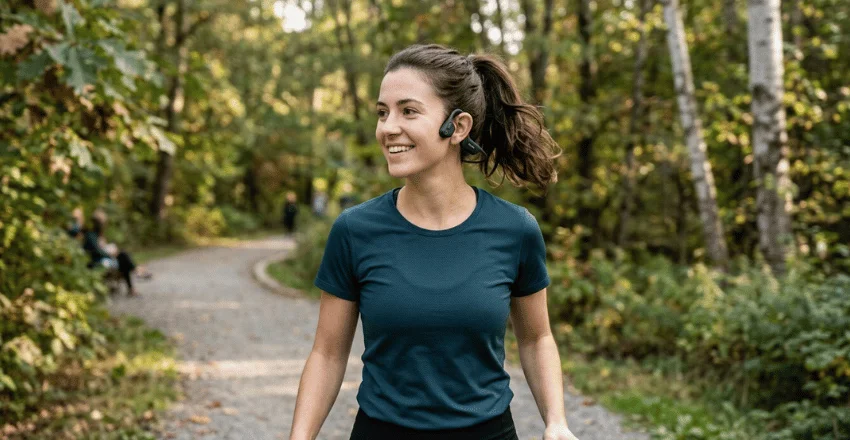
Start with your use case rather than the brand name.
1. Fit
Look for a frame that stays in contact with your head without creating uncomfortable pressure.
2. Water Resistance
For running, sweat resistance may be enough. For swimming, choose a model specifically rated for immersion.
3. Battery Life
Think about the length of your longest typical listening session rather than focusing only on the advertised maximum. A long-distance runner has different needs from someone taking 30-minute walks.
4. Onboard Storage
This matters most for swimmers because Bluetooth performance is severely disrupted underwater.
5. Controls
Physical buttons can be easier to use during exercise than touch controls.
6. Device Compatibility
Most wireless models pair with devices through Bluetooth. If you also use a tablet, Techriyon’s iPad 10th Generation guide provides useful background on the device’s wireless and audio connectivity.
7. Your Listening Environment
Open-ear listening works best when staying connected to your surroundings is an advantage. It works less well when you need quiet or strong noise reduction.
Who Should Buy Them?
These headphones make the most sense for people who value awareness and comfort more than isolation.
They are a strong match for runners, cyclists, walkers, fitness enthusiasts, and people who dislike inserting earbuds. Purpose-built waterproof versions can also work well for swimmers.
They are a weaker match for commuters in noisy environments, frequent flyers, or listeners who want maximum isolation from background noise.
The best buying question isn’t, “Which technology is newer?” It’s, “Which design best suits the way I listen?”
The Bottom Line
Open-ear vibration audio is most useful when shutting out the world would be a disadvantage. It gives runners, cyclists, workers, and some swimmers a way to listen without plugging their ear canals.
Before buying, decide what matters most to you: awareness, waterproofing, comfort, battery life, storage, or sound isolation. If awareness comes first, this category deserves serious consideration.
Explore Techriyon’s Gadgets and Apps coverage next for more comparisons and practical device guides.
FAQs
Many people can wear them with glasses, but comfort depends on how the glasses’ arms and the headset overlap. Try the fit before buying when possible.
They may hear some sound leakage, especially in a quiet room or at high volume. The amount depends on the headset’s design, fit, audio content, and playback level.
They can be used safely at sensible volume levels, but the open-ear design doesn’t prevent noise-related hearing damage. Keep the volume moderate and reduce your listening time when the sound level is high. WHO recommends keeping device volume at around 60% of the maximum or lower.