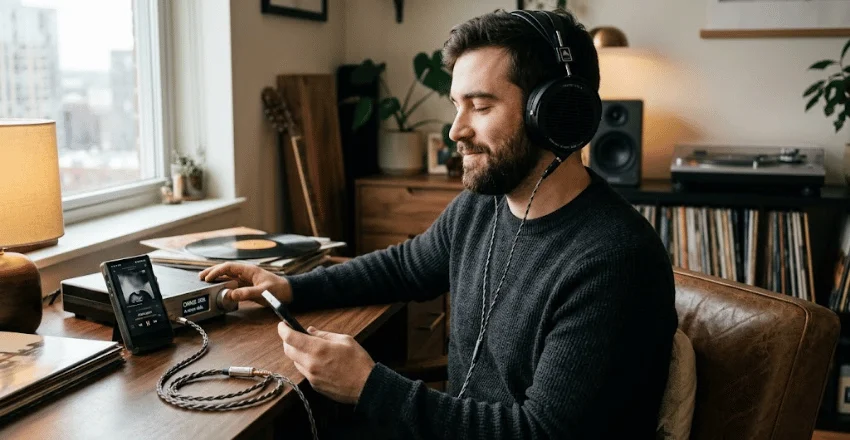
Bluetooth won the market, and then many listeners quietly went back to cables. It is not nostalgia. Wired headphones at $100 still out-measure a $300 wireless pair on raw sound; they cost nothing to run, and they never die halfway through a flight.
The complication is the plug. Four of them are now in circulation, and your phone may not accept any.
Short answer: Wired headphones send an uncompressed analog signal straight to the driver, so they sound cleaner than Bluetooth headphones at the same price and never run out of battery. You need the plug your device actually has, and you only need an amp if the pair is rated above roughly 80 ohms.
Which plug goes with which device
| Connector | What it carries | Devices that use it | Adapter needed? |
|---|---|---|---|
| 3.5mm | Analog audio | Budget Android phones, laptops, handheld consoles, airplane seats | No |
| USB-C | Digital audio, converted in the plug or earcup | Newer Android phones, iPad, Steam Deck | Only if your pair ends in 3.5mm |
| Lightning | Digital audio | iPhone 14 and older | Only if your pair ends in 3.5mm |
| 1/4 inch (6.35mm) | Analog audio | Audio interfaces, guitar amps, mixers, receivers | Screw-on collar from 3.5mm |
Key takeaways
- A cable carries the full signal uncompressed, so a modest pair beats pricier Bluetooth on detail.
- Match the plug to the device first. Everything else is secondary.
- USB-C models carry their own converter, so one can work on a tablet and stay silent on another port.
- Under 80 ohms, your phone drives it fine. At 250 ohms and up, budget for an amp.
- Closed-back for offices and flights, open-back for a quiet room.
- A detachable cable is the feature that most extends the life of the set.
Why the cable never really went away
Three things brought buyers back.
Price is the loudest. You are paying for drivers and a housing, not for a battery, a radio, a pairing chip, and a companion app that wants an account. Strip all of that out and the same $80 buys noticeably more sound, which is why studio engineers never left the cable behind in the first place.
Latency is the second. An analog connection has none you can perceive, so video stays in sync and games feel immediate. Even good low-latency Bluetooth modes run around 40 to 80 milliseconds, which is enough to make a rhythm game feel soft.
Longevity is the third, and the most underrated.
Lithium cells fade after three or four years, and owners can rarely replace them. Passive headphones have nothing to degrade except the pads and the cord. Both are cheap to swap.
Hardware kept up too. Plenty of current handsets keep the analog port, and the budget-friendly Nokia G310 is a good example of a recent phone that never dropped it. If you are shopping for a phone and a listening setup at once, that port is worth checking before you order.
Wired headphones vs Bluetooth: where the difference actually lives
People assume the gap is about resolution numbers. It is really about compression.
Bluetooth cannot carry a full-fat stereo stream. Every wireless connection therefore squeezes the file a second time, on top of whatever your streaming service already did to it. No codec on the market undoes that second pass.
| Connection | Approximate ceiling | Compressed? |
|---|---|---|
| Analog cable (3.5mm or 1/4 inch) | No data stream at all | No |
| SBC, the Bluetooth default | About 328 kbps | Yes, lossy |
| AAC, used by Apple devices | About 256 kbps | Yes, lossy |
| aptX HD | About 576 kbps | Yes, lossy |
| LDAC at its top setting | Up to 990 kbps | Yes, lossy |
| CD quality, for reference | 1,411 kbps | No |
Read the bottom two rows together.
LDAC, at its best, is still below CD, and it only maintains that rate on a strong, close signal. Walk into another room, and your phone quietly drops to a lower setting to keep the link alive.
Be honest about how much this matters. On a podcast or a noisy commute, nobody hears the difference. On acoustic recordings and anything with long reverb tails, the compressed version smears the decay.
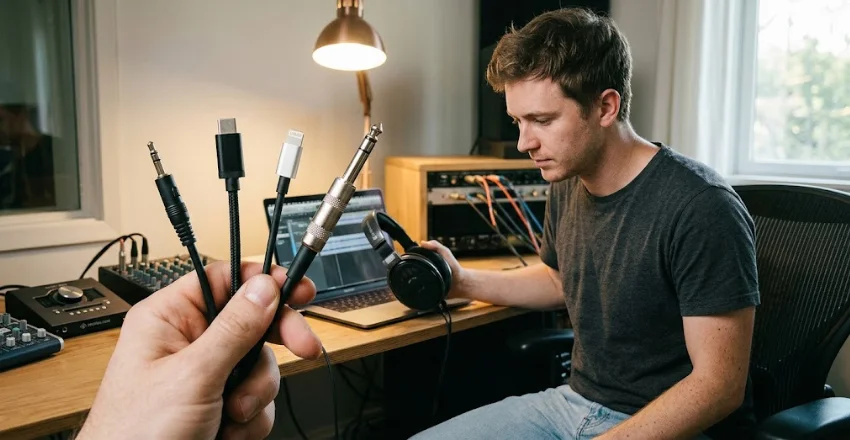
The four plugs, and how to pick yours
3.5mm, the default
This is the small round plug most people picture. It carries analog audio and, on a four-conductor version, a microphone signal too. Laptops, mixers, car stereos and airplane armrests all take it.
Handheld consoles are a quiet strong point here. Both the Switch and the Switch Lite kept an analog jack on the top edge, so a cheap pair works with no pairing menus and no lag.
USB-C, the awkward one
A USB-C pair is not simply a cable with a different end. Digital audio leaves the device and gets converted inside the plug or the earcup, so the pair carries its own converter chip.
Two consequences follow.
First, volume and tone are partly set by that chip rather than by your phone. Second, compatibility is not guaranteed. Some ports send only digital audio; others only analog; and a passive adapter fails with the digital-only kind. Look for the word “DAC” in the listing.
Lightning, for older iPhones
Lightning behaves like USB-C: digital out, converted in the accessory. It applies only to the iPhone 14 and earlier, since Apple moved the rest of the lineup to USB-C. Buying one now bets on a port that is on its way out.
1/4 inch, for gear that plugs in
The fat plug on studio and hi-fi gear measures a quarter of an inch across. Audio interfaces, guitar amps, keyboards, and receivers use it. Most studio headphones ship with a screw-on collar so one cord serves both sizes, and that collar is the first thing people lose.
Ohms and amps, in plain terms
Impedance is the electrical resistance of the driver, printed in ohms on the box.
Higher resistance means the same voltage produces less volume. A high-ohm pair therefore sounds thin and quiet on a device that cannot push hard enough, which is where the whole amp question comes from.
| Rating | Drives properly from | Do you need an amp? |
|---|---|---|
| 16 to 32 ohms | Phones, tablets, laptops, consoles | No |
| 33 to 80 ohms | Laptops, audio interfaces, most phones | Rarely, and only at high volume |
| 81 to 150 ohms | An interface or a dongle converter | It helps |
| 250 ohms and above | A dedicated amp or desktop converter | Yes |
One number is missing from that table: sensitivity, in decibels per milliwatt. A sensitive 250-ohm model can be easier to drive than an insensitive 32-ohm one. Under about 95 dB/mW is amp territory, whatever the ohms say.
The practical rule is boring, and it works. Buy the low-impedance version of whatever model you like, unless you already own an amp. Manufacturers often sell one design in 32, 80, and 250 ohm variants, and the 32 ohm variant is the one that sounds right from a phone.
Open-back or closed-back
Closed-back cups seal against your head. They keep your music in and outside noise partly out, which is what you want on a train, in a shared office, or anywhere a microphone is running.
Open-back cups have a grille instead of a solid shell. Air moves freely, the soundstage opens up, and instruments stop feeling stacked in the middle of your skull.
The trade is total. Everyone near you hears your music, and you hear everything near them.
That second half catches people out at a desk. A whining machine lands right in the mix, so it is worth quieting a noisy computer fan before you spend on an open design. Fix the room first, then buy for the room you have.
What to check before you buy
Start with the plug. Then work down this list.
- A detachable cable. Cords fail long before drivers do, usually right where the wire meets the plug. A pair with a removable cord can be repaired for about $15. A pair with a fixed cord becomes trash.
- Cable length and type. Roughly 4 to 6 feet is suitable for a phone. A 10-foot coiled cord suits a desk. Flat cables tangle less, and fabric-wrapped ones rustle against your collar.
- An inline remote, if you take calls. Three-button remotes are wired differently for iPhone and Android. The middle button usually works on both; the volume keys often do not.
- Replaceable earpads. Pleather flakes within two years, and orderable pads keep a good set going for a decade.
Four price bands cover almost everything you will see at list price in the US.
Under $50 gets honest sound in a plastic frame, and the Koss Porta Pro is the classic pick. Between $50 and $150, you reach genuine studio gear, where the Røde NTH-100 sits at $129 and the Austrian Audio Hi-X15 at $109.
From $150 to $350, you get better drivers and metal parts, such as the Grado SR325x at $295 or the Beyerdynamic DT 990 Pro X at $229.99. Past that, gains get small and specific, and a flagship like the Beyerdynamic T1 runs close to $1,000.
Most people should stop in the second band.
One more note on sources. If your device is USB-C only, like the 10th generation iPad, a $10 adapter works, but a $40 dongle converter drives a demanding pair far better. That small box is often a bigger upgrade than pricier earcups.
Where to start
Pick up your phone, laptop, and console, and write down which ports each one has. That list decides your plug and rules out half the market in a minute.
Then set a budget in the $50-$150 range, choose closed-back unless you listen alone, and check that the cord comes off. Get those four calls right, and the headphones will last you years.
Frequently asked questions
Almost never, and this is the most common reason people send a pair back.
Active noise canceling needs power, and a passive pair has none. You get passive isolation instead, which a well-sealed closed-back does surprisingly well on steady low rumble. If noise canceling is your priority, a cable is the wrong choice and no amount of shopping will change that.
Yes.
Buy a USB-C or Lightning adapter that names a DAC in its description, or buy a pair that terminates in the port your phone already has. Avoid the cheapest unbranded adapters, which often work on one device but remain silent on the next.
No. Once a cable is shielded and correctly terminated, a $200 cord measures the same as a $20 one. Spend the difference on the drivers or on a decent converter, where you can hear it.
Earbuds win on portability and on anything involving a gym bag. Over-ear headphones win in comfort during long sessions, isolation, and bass response. If this is your only set and it lives at a desk, go over-ear.
Nine times out of ten, the cord has broken near the plug from repeated bending. Wiggle the cable while audio plays to confirm. On a detachable design, that is a cheap swap.