
A four-letter caption can turn an ordinary post into a private wink. That is why this slang appears so often in texts, captions, comments, and group chats. The real message depends on a joke, memory, reference, or experience that a particular audience already understands.
IYKYK means “if you know, you know.” People use it when a joke, memory, reference, or experience makes sense to a specific group without extra explanation. In texts and social posts, it signals shared context. People who understand the reference get the point, while others may miss what makes it meaningful.
| Quick fact | What it means |
|---|---|
| Full phrase | “If you know, you know” |
| Main purpose | Signals an inside joke or shared experience |
| Common places | Texts, captions, comments, memes, and group chats |
| Typical tone | Playful, knowing, nostalgic, or teasing |
| Best use | When your audience already understands the reference |
| Possible downside | It can feel excluding if important context is withheld |
What Does IYKYK Mean?
The abbreviation stands for “if you know, you know.” Merriam-Webster describes the phrase as a way to acknowledge shared knowledge or experience. Cambridge Dictionary also defines it as an abbreviation used in texts and social media when people share a joke or piece of knowledge.
Think of it as a signal rather than a complete statement. The writer is telling a specific audience, “You already understand why this matters.” There is no need to explain the backstory to people who were there or already know the reference.
That shared understanding is what gives the phrase its appeal. A plain photo of a diner, airport gate, game screen, or office printer might mean little to most viewers. To the right group, however, it could bring back an entire story.
How the Slang Works in Texts and Social Media
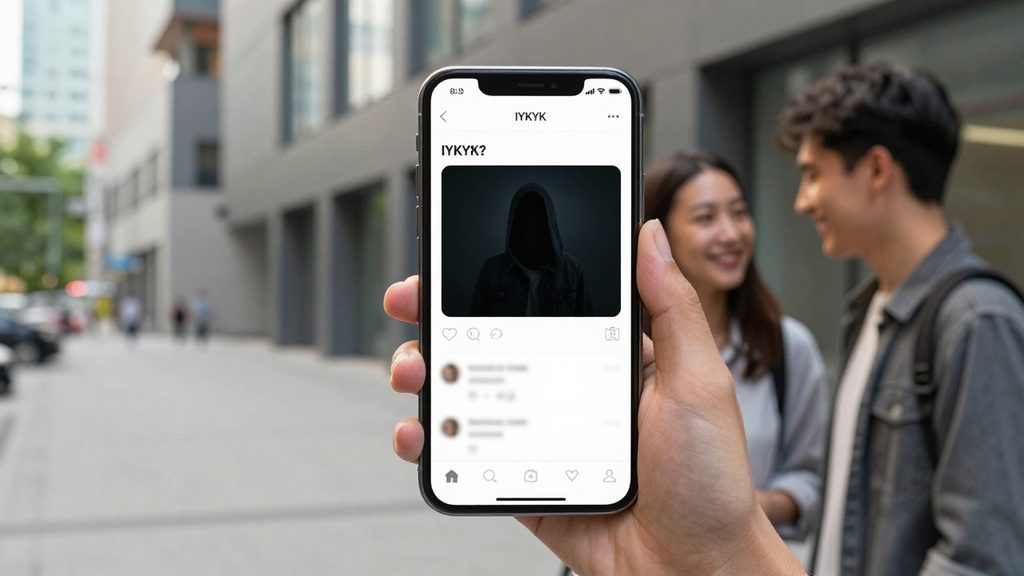
In a private text, the phrase often points to a memory between friends. Someone might send a photo of a familiar parking lot with a short caption. The recipient already knows what happened there, so the unexplained reference becomes part of the joke.
On social platforms, the audience can be larger while the idea stays the same. Hootsuite, for example, includes “if you know, you know” among short caption ideas for TikTok. Dictionary.com also notes that the abbreviation commonly appears in online posts and as a hashtag.
This style of communication fits the wider shift toward short, context-heavy online language. Techriyon’s Digital Revolution coverage explores how connectivity changes everyday communication. Its Gadgets and Apps section also covers the devices and apps through which these habits develop.
In Group Chats
Group chats are a natural home for insider language because members already share a history. One photo, date, emoji, or location can carry far more meaning than it would for an outsider.
For example:
“Someone booked table 12 again. You know the story.”
Friends who remember the original event need no explanation. Everyone else would need the missing context.
In Captions and Comments
A social media caption can work the same way. The post may show something ordinary while hinting that a smaller group sees a second meaning.
That creates two layers. Anyone can view the post, but only part of the audience understands why it was shared.
Examples of What It Sounds Like in Real Conversations
IYKYK often works like a quiet wink between people who already share the background. The words before it matter more than the abbreviation itself.
| Context | Example | What the writer implies |
| Travel | “Gate B17 at 2 a.m. Never again.” | A memorable trip story |
| Gaming | “That one hidden room behind the waterfall.” | Players know about a secret location |
| School | “Tuesday lunch in the old cafeteria.” | Former classmates share a memory |
| Work | “A Friday deployment at 4:55 p.m.” | Colleagues know why that timing is risky |
| Fandom | “The opening note was enough.” | Fans recognize a song, scene, or event |
The strongest examples do not force the phrase into random posts. They start with a reference that already has meaning for the intended audience.
That is also why brands can sound awkward when they copy insider slang without having a genuine shared reference with their audience. The phrase works best when that shared context has developed naturally.
Where Did the Slang Come From?
There is no solid evidence that one celebrity, song, or social platform invented the expression. Dictionary.com reports that the abbreviated form has been used on social media since at least 2009 and gained broader popularity during the mid-2010s.
Its recognition has since moved beyond informal posts. Cambridge Dictionary added the abbreviation as part of a wider group of internet and social media terms in 2024.
That history is useful because online claims sometimes credit a single viral moment with creating slang that was already in circulation. Music, memes, and popular accounts can accelerate the spread of a phrase without being its original source.
When the Phrase Feels Fun and When It Feels Excluding
Insider language can create a sense of belonging. A small reference can remind friends, coworkers, fans, or community members of something they experienced together.
The same mechanism can also exclude people. If the message concerns harmless nostalgia, that mystery is often part of the fun. If someone needs the missing information to participate in a conversation, however, withholding it can feel dismissive.
Context matters even more online because tone can be difficult to read. Research on context-sensitive online language has also shown why automated systems can struggle with language that depends heavily on group knowledge. That research is broader than this specific abbreviation, but the principle is relevant.
For more on technology that interprets human language and context, Techriyon’s AI Tech section covers artificial intelligence, machine learning, and related tools.
How to Respond If You Don’t Know the Reference
You do not need to pretend you understand. A simple response usually works better.
- Ask directly: “What’s the reference?”
- Keep it light: “Okay, I clearly missed this story.”
- Ask a friend privately: This can be useful when the reference appears in a large group.
- Leave it alone: Not every inside joke requires an explanation.
- Request clarity at work: If the missing context affects a task or decision, ask for the full meaning.
The setting should guide your response. A mysterious holiday photo is harmless. An unexplained reference in project instructions is different because the missing context can affect other people.
The Takeaway
“If you know, you know” is simple because most of its meaning exists outside the words themselves. It tells the right audience that a shared joke, memory, community, or experience provides the missing context. The next time you see the abbreviation in a text or social post, look at what came immediately before it. The photo, joke, sound, location, or conversation usually contains the clue.
For more explanations of how technology shapes online communication, browse Techriyon’s Digital Revolution and Gadgets and Apps coverage.
Frequently Asked Questions
Not by itself. It is usually playful or nostalgic. It can feel rude if someone deliberately uses missing information to exclude others from a conversation that concerns them.
It usually tells viewers that a caption, image, sound, or situation has extra meaning for people who are familiar with a specific reference. The basic meaning stays the same across major social platforms.
It is often used as a shortened variation of “you know, you know.” Its meaning can depend on context, so the surrounding message matters more than the letters alone.
Yes. People may say the full phrase rather than pronounce each letter individually. Dictionary.com notes that the written abbreviation is commonly understood as the full expression.
They can, but it works best when the audience genuinely shares the reference. A brand that forces insider language into an unrelated promotion may sound less natural than one that uses a plain caption.