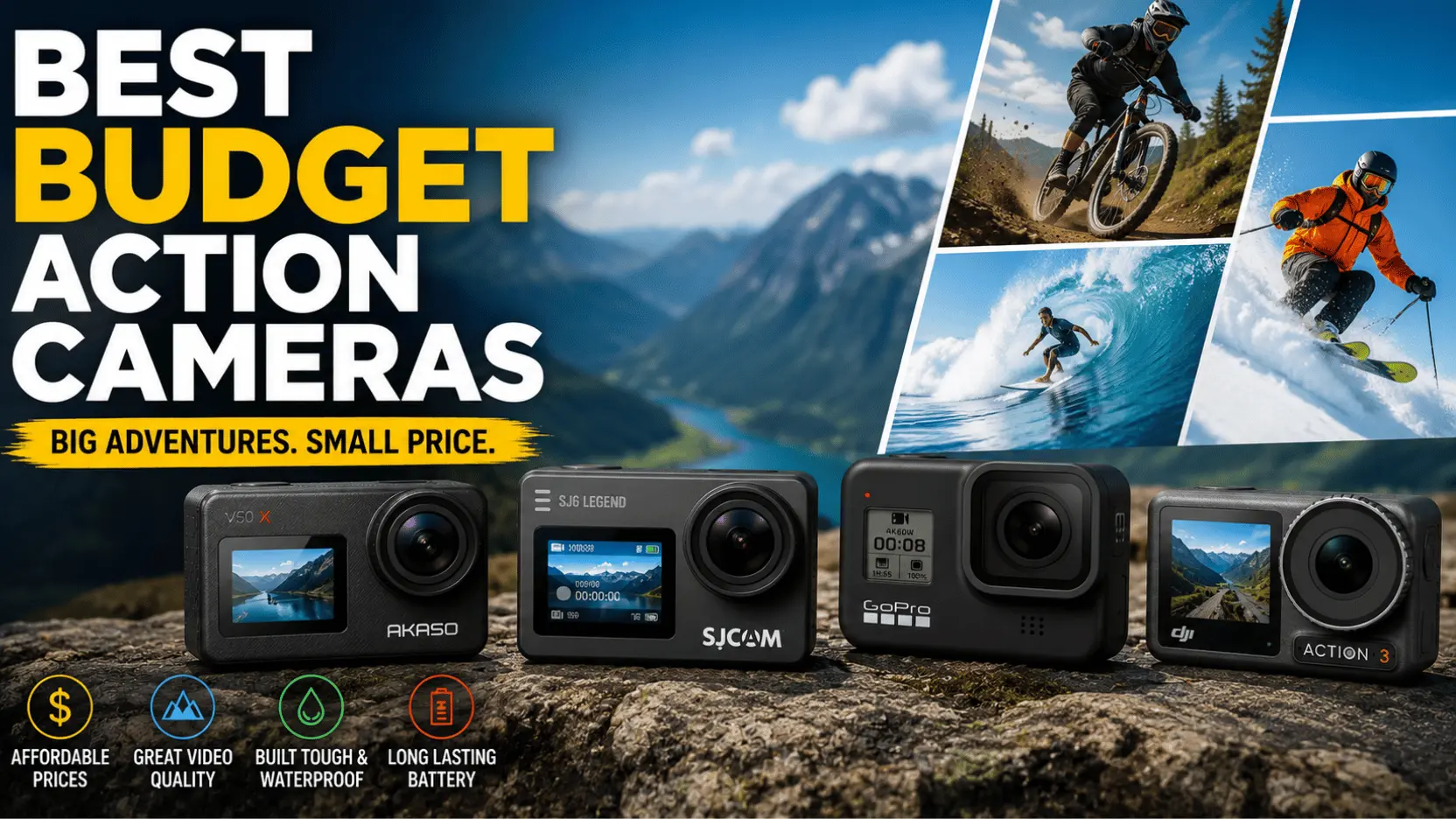
Buying a cheap camera is easy. Finding one that records smooth, usable footage is harder. The best budget action cameras give you reliable stabilization, practical waterproofing, and enough resolution for the way you shoot.
| Best Budget Action Cameras | Recent price signal | Max video | Stabilization | Water protection | Best for |
| DJI Osmo Action 4 | About $169 on a recent sale; $239 standard listing | 4K/120 fps | RockSteady / HorizonSteady | 18 m without a case | Best overall value |
| GoPro HERO | About $199 to $220 | 4K/30 fps | HyperSmooth through Quik workflow | 5 m without a case | Small, simple setup |
| AKASO Brave 7 LE | Often below $140 | 4K/30 fps | 6-axis EIS | IPX7 body; deeper with a case | Vlogging on a budget |
| AKASO Brave 4 Pro | Around $100 | 4K/30 fps | Electronic stabilization | 40 m with housing | Best under $100 |
| SJCAM C300 | Varies by retailer | 4K/30 fps | 6-axis gyro | 30 m with a case | Long recording sessions |
Prices change often, especially for older DJI and GoPro models. The figures above reflect current manufacturer listings and recent 2026 buying guides rather than permanent MSRPs.
Key Takeaways
- The DJI Osmo Action 4 gives most buyers the best mix of video quality, stabilization, durability, and price.
- A previous-generation premium model can offer better value than a brand-new ultra-cheap camera.
- The AKASO Brave 4 Pro makes more sense when your budget is close to $100.
- Front screens help vloggers frame themselves without guessing.
- Waterproof claims need context. Some cameras require a housing before they can handle deeper water.
- Frame rate and stabilization can matter more than a large “4K” label for sports footage.
For more affordable device roundups, TechRiyon’s Gadgets & Apps section is a useful next stop.
How We Chose the Best Budget Action Cameras
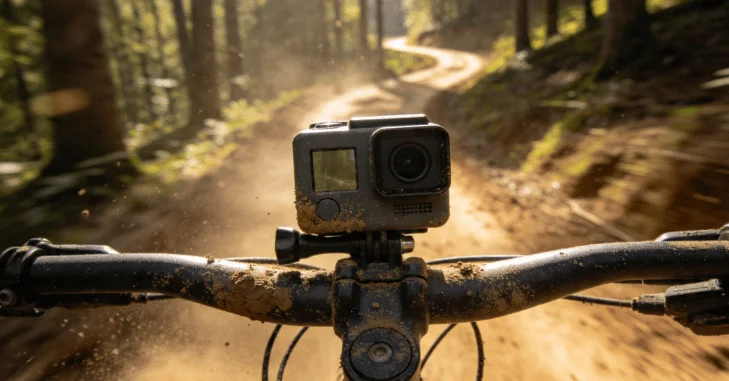
This ranking focuses on the features that affect the footage you bring home. These include stabilization, frame rate, sensor size, water resistance, battery options, screen design, and accessory support. Price matters, but being cheap is not enough. A $90 camera becomes poor value if shaky video makes half your clips unusable. We also favored models with current manufacturer information and recent independent coverage. This is a research-based comparison, not a claim that TechRiyon personally tested every camera.
One useful pattern appears across current recommendations: older premium models often fall into the budget range after newer generations arrive. Tom’s Guide currently treats the Osmo Action 4 as a strong low-cost choice, while recent TechRadar coverage highlighted a $169 sale price.
1. DJI Osmo Action 4: Best Overall Value
The Osmo Action 4 is the pick to beat when its price is around $200. DJI built it around a 1/1.3-inch sensor, and it supports recording at up to 4K/120 fps. It also offers a wide 155-degree field of view and 10-bit color options. Its biggest advantage is balance. You get serious slow-motion flexibility, strong electronic stabilization, and waterproofing to 18 meters without adding a housing. Dual touchscreens also make self-recording easier.
Current independent guides continue to place it near the top of the value category. Tom’s Guide selected it as a recommended budget action camera, while Digital Camera World also named it a leading budget video option.
Pros: 4K/120fps recording, a large sensor for this price class, dual screens, strong stabilization, and generous case-free water protection.
Cons: The standard DJI listing can cost more than entry-level rivals. Its value becomes much stronger during sales.
2. GoPro HERO: Best for Simplicity and Portability
GoPro’s compact HERO takes a different approach. It weighs 86 grams and records at up to 4K/30fps, with 2.7K/60fps available for slow-motion clips. GoPro rates the body as waterproof to 16 feet, or about five meters. Its small body is the main attraction. Built-in mounting fingers also work with GoPro’s large accessory ecosystem.
There is one tradeoff worth understanding before you buy. HyperSmooth stabilization for HERO footage is applied through the GoPro Quik app rather than being processed in-camera in the same way as it is on higher-end models. That makes it better suited to casual users who value size and simplicity over maximum frame rates.
Pros: A tiny 86-gram body, a well-established mounting ecosystem, 4K capture, and simple controls.
Cons: 4K tops out at 30fps, water resistance is shallower than on the DJI, and stabilized results depend more heavily on the Quik workflow.
3. AKASO Brave 7 LE: Best for Budget Vlogging
The Brave 7 LE is a practical choice if you want to see yourself while recording. It has a rear touchscreen and a front display, which removes much of the guesswork from selfie framing. AKASO lists 4K/30fps recording, 20-megapixel stills, six-axis electronic stabilization, and an IPX7-rated body. The camera also works with the AKASO Go app. Recent coverage has placed it below roughly $140 and highlighted its dual screens, two included batteries, and accessory bundle. Those extras matter on a tight budget. A low camera price is less impressive if you immediately need to buy another battery, case, or mount.
Pros: A front screen, two-battery bundles, 4K recording, stabilization, and useful included accessories.
Cons: It tops out at 4K/30fps, and independent reviews place its stabilization and image quality below those of premium DJI and GoPro models.
4. AKASO Brave 4 Pro: Best Under $100
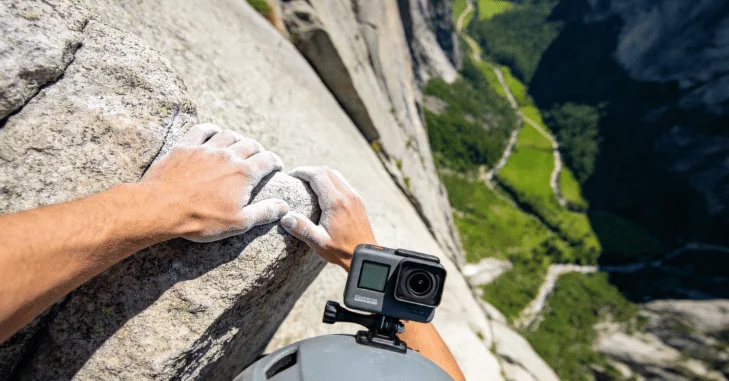
If $100 is a firm ceiling, the Brave 4 Pro is one of the clearest current choices. Digital Camera World’s 2026 budget guide ranks it at the top of its sub-$100 group. The camera records 4K at 30 fps and includes front and rear displays. Its waterproof housing is rated to 40 meters, giving swimmers and occasional snorkelers more flexibility than an exposed splash-resistant body.
Battery life is quoted at roughly 90 minutes in that review, although recording settings and temperature can affect real-world runtime.
Pros: A low purchase price, dual screens, usable stabilization, 4K/30fps recording, and a deep-water housing.
Cons: It lacks the high-frame-rate 4K modes and larger sensor found on the DJI.
5. SJCAM C300: Best for Long Recording Sessions
The SJCAM C300 stands out because of its modular battery design. The camera supports 4K/30 fps recording, six-axis gyro stabilization, dual 1.3-inch touchscreens, and both 2.4GHz and 5GHz Wi-Fi. SJCAM also includes a larger 2,800mAh battery module in its system. The manufacturer claims up to six hours of continuous HD recording with that larger module. Actual runtime will depend on your settings and recording conditions.
With its case fitted, the C300 is rated for use in water down to 30 meters. It supports microSD cards with capacities of up to 128GB.
Pros: A flexible battery setup, dual screens, 4K recording, gyro stabilization, and useful connectivity options.
Cons: Its 4K mode tops out at 30fps, and retail pricing can vary enough that you should compare it with discounted DJI hardware before buying.
What Matters More Than the 4K Label
Two cameras can both say “4K” on the box and still produce noticeably different footage. Resolution tells you how many pixels are recorded. It does not tell you how stable, clean, or easy to edit the footage will be.
For biking, skiing, running, or other fast-moving activities, frame rate deserves close attention. The Action 4 can shoot 4K/120fps, while the cheaper AKASO models discussed here top out at 4K/30fps. The higher frame rate gives you more frames to work with during fast movement and slow-motion editing.
Stabilization matters for the same reason. A sharp frame is less useful if every bump causes the image to shake.
Waterproofing also requires careful reading. DJI rates the Action 4 to 18 meters without a case. GoPro rates the HERO at five meters. The Brave 4 Pro reaches 40 meters with its protective housing. These are different types of claims, so they should not be treated as a direct apples-to-apples comparison.
Storage is another easy detail to overlook. DJI lists microSD support of up to 512GB for the Action 4, while SJCAM specifies a 128GB maximum for the C300. Always check the manufacturer’s supported-card guidance before ordering storage.
If you are building a road-trip recording setup, TechRiyon’s guide to wireless Android Auto adapters can help with the in-car side of your setup.
Which One Should You Buy?
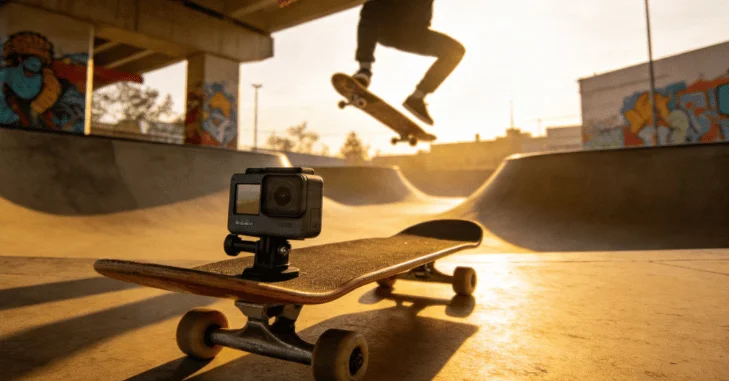
Choose the DJI Osmo Action 4 if your budget can stretch to around $200. It offers the strongest combination of frame rate, sensor size, stabilization, dual displays, and waterproofing in this group. Recent discounts make this older flagship especially attractive. Pick the Brave 4 Pro when $100 is your limit. Choose the Brave 7 LE when a front screen and bundled accessories matter more than high frame rates.
The GoPro HERO makes sense when you want something small and straightforward. The SJCAM C300 is more appealing for long recording sessions, where its larger battery module becomes especially useful. The key buying rule is simple: don’t pay extra for resolution alone. Match the camera to the type of movement, water depth, recording duration, and framing style you expect to use.
Final Verdict
For most buyers, the DJI Osmo Action 4 is the one to get when it is discounted to around $200. It gives up little where it matters and offers much more recording flexibility than most ultra-cheap rivals. If you are spending closer to $100, the Brave 4 Pro becomes the smarter compromise. Vloggers should also look closely at the Brave 7 LE because of its front screen and bundled batteries.
Before paying, compare the current street price with the price of the next model up. Sales can turn yesterday’s premium camera into today’s better budget buy. You can continue comparing affordable gear in TechRiyon’s wireless keyboard and mouse buying guide and its wider Gadgets & Apps coverage.
Frequently Asked Questions
The AKASO Brave 4 Pro is the strongest current sub-$100 option in Digital Camera World’s 2026 comparison. It records 4K/30fps, has dual screens, and includes a waterproof housing rated to 40 meters. The AKASO V50X is another low-cost alternative with 4K/30fps recording and electronic stabilization.
Usually not in every area. Low-cost models tend to compromise on stabilization, high-frame-rate recording, low-light quality, software, or several of these areas at once. An older premium camera on sale can narrow that gap, which is why the discounted Action 4 offers such strong value.
Some are waterproof without extra protection, while others require a housing for deeper water. Check whether the quoted depth refers to the bare camera or an included case. DJI rates the Action 4 to 18 meters without a housing, for example.
Start with the camera manufacturer’s supported capacity and speed guidance. The Action 4 supports cards with capacities of up to 512GB, while the C300 lists a 128GB maximum. Matching the card to the manufacturer’s specifications can help prevent recording problems at higher resolutions.