

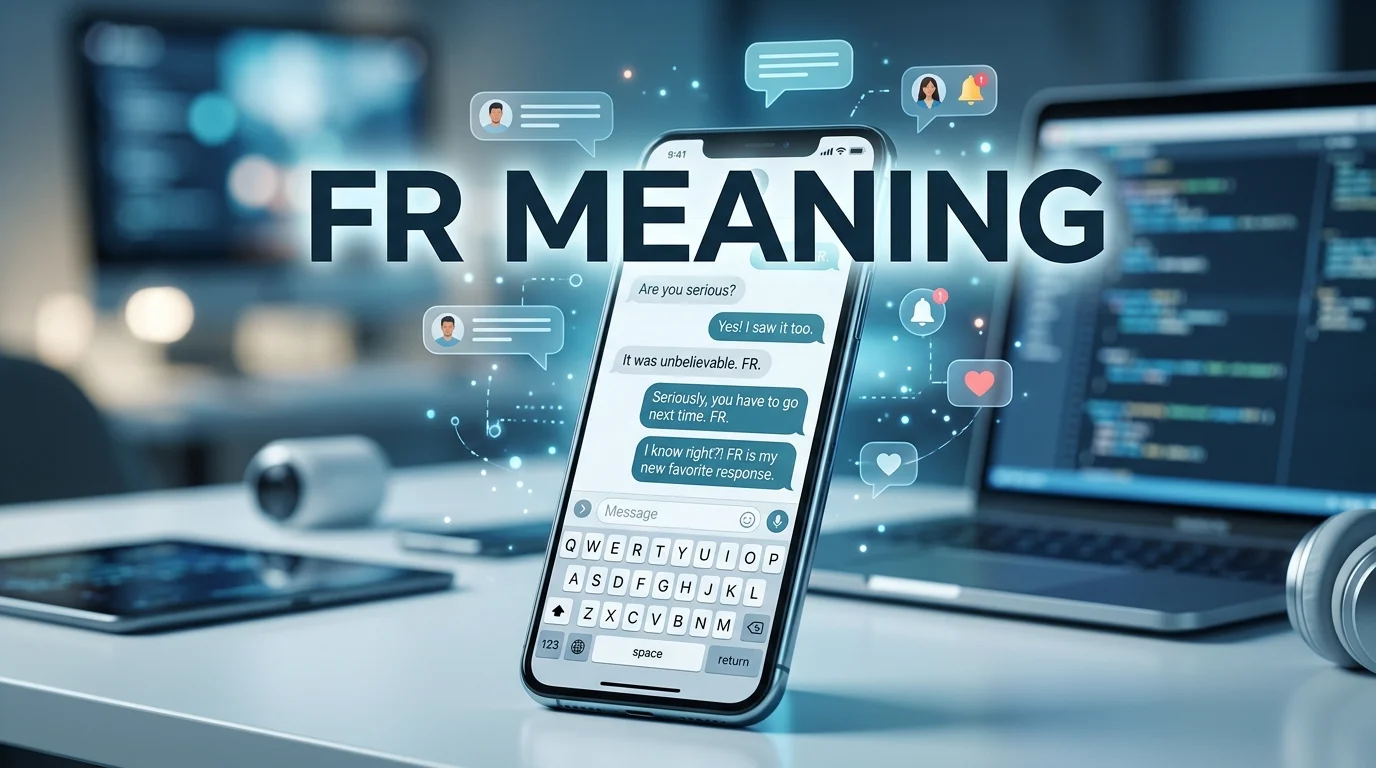
Someone replies to your message with two lowercase letters and no explanation, and you cannot tell whether they agree with you or have quietly called you a liar. FR is short for “for real,” and most of the time the person is backing up what you just said. Those same two letters can also ask “seriously?” so punctuation and position do the real work.
Short answer: The abbreviation is texting shorthand for “for real,” and people send it to agree with a statement or to stress that they are being honest. With a question mark attached, it asks whether something is true. It carries the weight of saying “honestly” out loud, in two characters.
Quick reference: the shorthand and its neighbors
The terms below travel together in the same chats. Learn one, and the rest will stop looking like code.
| Shorthand | Full phrase | What it signals | Most common home |
|---|---|---|---|
| fr | for real | Agreement, or honest emphasis | Texts and TikTok comments |
| frfr | for real for real | Stronger agreement, no room left to argue | Replies to big claims |
| ngl | not gonna lie | A small confession is coming | Group chats |
| no cap | no exaggeration | The speaker is not joking | TikTok and song lyrics |
| deadass | completely serious | A New York-flavored version of the same idea | DMs and comments |
| ong | on God | A promise that the claim is true | Gaming chat |
Where the term came from
None of this slang is new. People have said “for real” out loud for decades, and “for realz” was the 1990s spelling that now sounds like a parent trying too hard. Texting shaved the phrase down to the two letters that carry the sound.
This short form spread the way chat shorthand usually does. Song lyrics used it, group chats copied the lyrics, and short video captions turned it into a reflex. By the time it saturated comment sections, it had stopped feeling like slang to anyone under thirty, and started behaving like punctuation.
Position changes what it means
Here is the part most definitions skip. Those two letters mean different things at the front of a sentence, at the end of one, and standing alone. Doubling them into frfr does not change that rule, so every example below reads the same either way.
| Where it sits | Example | What the sender means |
|---|---|---|
| Leading the sentence | “For real, that update wrecked my battery life.” | I am sincere about what follows |
| Trailing the sentence | “That update wrecked my battery life frfr.” | Emphasis on the whole claim, like underlining it |
| Alone and flat | “frfr” | Agreement, and nothing more is coming |
| Alone with a question mark | “frfr?” | Disbelief. Confirm it or prove it |
There is a fifth reading the top search results ignore. Sent flat after a claim that sounds inflated, the reply turns sarcastic, and the sender means roughly the opposite of agreement. Context gives it away. If you just said something enormous and the answer is two dry letters with no follow-up, you are being doubted rather than backed up.
Capitalization matters more than you would expect. Lowercase is the default and reads as casual. All capitals read as shouting, or as sarcasm, to most people under twenty-five, so FR in a friendly chat can land colder than you meant it to.
Where you will see it most
The abbreviation is not tied to any one app. It appears in iMessage, WhatsApp, Instagram captions, Snapchat replies, and TikTok comments, and the meaning survives the trip between them. There are small differences in how each crowd uses it:
- TikTok. Almost always a one-word comment agreeing with the video. It is the fastest way to say “this is accurate” without writing a review.
- Snapchat. Usually a reply inside a fast back-and-forth, where a full sentence would slow the thread down.
- Instagram. More often, a caption tag is added to the end of a post so the joke reads as sincere underneath.
- Group texts. Pure agreement, sent so nobody has to type “yes, I think so too” six times.
Hardware changes nothing. That same message renders identically on an iPhone and on the Nokia G310, an everyday Android phone. These are plain-text characters, not emojis that require font support on both ends.
FR vs FRFR, and why people double it
Doubling is an intensifier and nothing more. One pair of letters says the speaker is sincere. Repeat it, and they are sincere while expecting an argument, so they have already closed the door.
The difference shows up clearest in replies to claims that strain belief. “I got concert tickets” earns the short form. “I got front row tickets for free” earns the doubled one. People sometimes stretch it further in comment threads, though anything past two repeats reads as a joke about the slang itself rather than sincerity.
Gaming chat, Discord and party chat

Games are where this shorthand earns its keep. Typing during a match can lose you the match, so a two letter agreement beats a full sentence every time. Discord text channels, in-game lobbies, and party chat all run on the same compressed vocabulary, and new players pick it up within a session or two.
Console players get there too, even without a real keyboard. Anyone thumbing out messages on a Nintendo Switch or Switch Lite has an obvious reason to prefer two letters over twelve.
How to reply when someone sends it to you
You never have to answer with the same shorthand. Match the meaning instead, and read the punctuation before you type anything.
- They agreed with you. Keep the thread moving. Add the next detail, or send a short “right?” and let the conversation carry on.
- They asked whether you are serious. Answer plainly. “Yeah, I promise,” or a quick screenshot settles it faster than more slang does.
- They sound sarcastic. Give one concrete detail instead of repeating the claim. Specifics end doubt, and volume never does.
Typing it without autocorrect fighting you
Phone keyboards dislike two-letter words they do not recognize. Autocorrect capitalizes the pair at the start of a message, or swaps it for a word it prefers. What you send then reads wrong to the person on the other side.
Two fixes take about a minute each:
- iPhone. Open Settings, then General, then Keyboard, then Text Replacement, and save the pair as its own entry so the keyboard stops rewriting it.
- Android. Open Settings, then System, then Languages and input, then your personal dictionary, and add the pair there.
- Either one. Switch off auto-capitalization if lowercase matters to you, though that setting applies to every message you send, not just this one.
When to leave it out
Work is the obvious line. In a professional email, a client message, or a Slack channel your manager reads, the shorthand reads as careless rather than warm. Nobody outside your group chat owes you the benefit of the doubt on tone. For the full picture, read IIRC in Everyday Messages.
Swap it for something that carries the same meaning without the risk.
- “Agreed” for plain agreement.
- “Seriously” or “genuinely” for emphasis.
- “Can you confirm that?” for the question form.
- “I mean that” when you want the sincerity to land.
Apply the same caution with anyone much older than you, and with anyone whose sense of humor you have not tested yet. Slang works because both people share the code, so it fails quietly whenever one of them does not.
The other meanings your phone might show you
Search those two letters, and a few unrelated results turn up. None of them have anything to do with your group chat:
- A country and language code. Phone region settings and web addresses use a two-letter code for France, which is why the pair appears in menus you never intended to open.
- A periodic table symbol. Chemistry uses it for francium, element 87.
- A religious title. In front of a priest’s name, it is short for Father.
Nobody in a text thread means any of these. If the message came from a friend, read it as slang and move on.
Key takeaways
- The abbreviation means “for real” and usually signals agreement.
- Position decides tone: the front is sincerity, the end is emphasis, and standing alone with a question mark is disbelief.
- Doubling the letters raises the volume without changing the meaning.
- Lowercase is normal, and capitals read as shouting or sarcasm.
- Keep it out of professional email and client messages, and write “agreed” or “seriously” instead.
Frequently asked questions
Sincerity, most of the time. Someone answering a compliment with it is telling you they meant what they said rather than hedging.
Only in a casual internal channel where your colleagues already write that way. In anything a client or a manager reads, write “agreed” or “seriously” instead.
Exactly what it means everywhere else. Snapchat replies are short by design, so two letters do the job of a whole sentence of agreement.
Yes. Nothing about the term is explicit or coded, so a parent who spots it in a child’s messages will likely see ordinary teenage shorthand rather than a warning sign.
Not by itself. It reads as rude only when the tone is sarcastic or when it appears in a formal context where a full sentence was expected.
Only intensity. Doubling makes it louder and leaves less room for argument, but both suggest the speaker is being straight with you.
It means “for real,” so the sender is agreeing with you, stressing that they are honest, or asking whether you are serious. Punctuation tells you which of the three you got.
What to do next
Take a screenshot of the quick reference table above and keep it somewhere you can find it again. Next time an unfamiliar abbreviation lands in your messages, check where it sits in the sentence and what punctuation follows. That pair of clues decodes most texting slang faster than any dictionary will.





, including its uses, meanings, examples, tone, and common variations.)